Why is all voting based on LSU and not total XRD?
1 Like
I voted no because i believe LSU should not be the only thing that matters with respect to governance.. XRD in all its forms should be used in governance. What about LSULP. Just using LSU penalizes DeFi users.
1 Like
Basically, because I felt it should be necessary to ensure that the voting “members” weren’t able to simply fly in and vote and then leave just as quickly. (i.e. Buy/pump; vote; Sell/dump)
Forcing a delay on the above implies they are generally more closely aligned with the success of the Radix network.
Users of the network e.g.
-traders with free XRD sitting in a wallet;
-LSULP employed in a DEX;
-users with assets locked in a lending protocol..etc
are merely “customers” of the network and are generally mercurial in their search for immediate yield (and there is NOTHING wrong with that).
However, they don’t generally concern themselves with the continuity of the network and will jump ship to the next platform that provides them better value (as ANY customer should).
Humorous examples for why they probably shouldn’t be included in the governance operations:
-
I buy hamburgers from McDonalds. I should have a say in how their operations are ran. Good luck with that.
-
Do Binance or Coinbase allow their customers to have a governance vote?
While wildly different in their scope, the above examples hopefully point out the differences between “customers of a network” and “members of an organization” that are collectively working to ensure the success of the network.
1 Like
You want to disenfranchise a large part of the community who don’t sit in LSU/staking. I don’t agree with your customers vs members. A DAO is of token holders. My vote shouldn’t be reduced just because I hold XRD or someother derivative because I actually use the network. Why should people who sit there like smaug staking and collecting XRD doing nothing else for the ecosystem be the only ones with a voice.
cross posting
Those are valid arguments. Thank you for providing the additional reasoning and explanation.
As such, I believe we should most likely put this up for another consultation vote.
Thanks again for taking the time to defend your position clearly and concisely.
Some feedback to the proposal:
Traditionally, long-term vision and strategy are set by a relatively small group operating within a company or foundation. In the case of a foundation, there may be a formal community body influencing that direction. That group would be typically determining which problems are worth solving, the time horizons, and where the focus should be (e.g. scaling, privacy, UX, interoperability), without necessarily setting the implementation details.
In the model proposed here, there does not appear to be an equivalent group defining strategy upfront. Instead, direction seems to emerge indirectly - sort of inferred over time from what gets built, what the DAO chooses to fund, and what ultimately makes it onto the network - the strategy becomes visible largely after the fact. Is that a fair characterisation?
While the model is strong on decentralisation, it is less obvious where that vision or strategic alignment comes from - or whether the absence of that is an intentional design choice rather than an unresolved gap?
Does this not increase the risk of taking a more circuitous path, burning capital along the way, and joining the L1 graveyard?
Finally, how should this model be seen relative to Uniswap? Is it broadly replicating the DAO and Accountability Committee approach, or are the proposed committees intended to somehow compensate for the absence of the Foundation and Labs entities that I understand also play role in the Uniswap ecosystem?
This is a highly important question!
The “normal” method you alluded to is basically the “top down” method of control by an organization. There are indeed many strengths with this method, but it also does have it’s weaknesses as well. For our space (crypto) I believe a more agile framework is needed to ensure survival.
I’d recommend looking up Henry Mintzberg’s work on “Emergent Strategy” (and by inference an emergent governance model like we are attempting).
Here’s a simple A.I summary of the attributes and benefits of emergent governance which I believe greatly align with our community’s overarching vision: Radix as the global public decentralized layer for all assets.
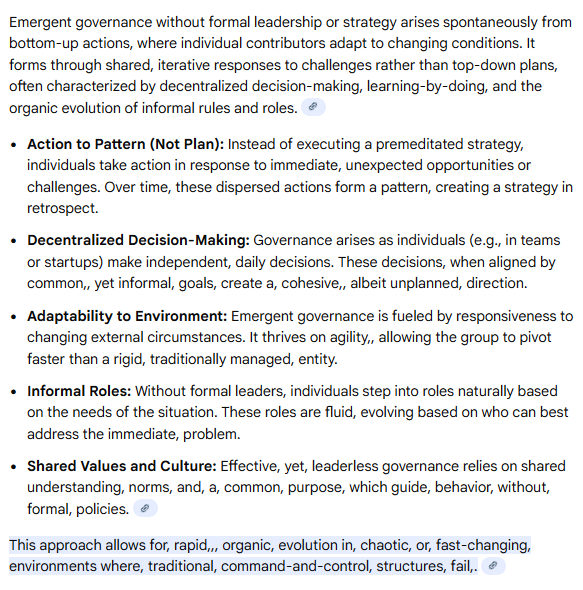
Interestingly though, one of the biggest critiques of emergent strategy seems to be that it’s not ideal for irreversible, mission critical decisions because emergent strategy revolves around the ability to quickly try things, see if they work, double down if they do or abandon if they don’t. I think this works for most things we do in crypto, but upgrades to mission critical L1 infrastructure don’t really fit into that bucket.
Indeed. That’s why it will be critical to have a dev-net and test-net separately so that any bugs/issues can be hammered out before pushed to prod.
I imagine we would all be merry if we could run this as close as possible to a Society of Commons, the Radix network and technologies being the Commons in question.
But it’s hardly sustainable that we can start off-the-bat as so, not with our historical baggage, our immense community diversity and the pressing operational needs.
Compromises in the short-term will be warranted to bootstrap, as I infer most of us can agree on.
As such, we must agree on the end-game/goal for this along with the bootstrap option and just start.
For me, the RAC is the bootstrap compromise and as long as we manage to have decent and aligned ppl in there, we can work our way into that end-game, I’m convinced of that.
Not entirely sure we’ll be able to get the best possible RAC members to start with, given the nature of the way the space works and how we’re mostly just using self-appointment and economic/token based voting for that … but fuck it, we can’t just wait for a better way to do it, we must act now, so I’ll take it (why I volunteered, btw)
1 Like
moving from telegram chatting to a forum it is a great improvement to discuss this kind of matter. btw it is true what you say and a strategy or something like should emerge or at least be clearer.
if we really want we should have a kind of board, an heatmap to note what it is more strategic… a lot of this notes are already know… liquidity, users, scalability test
perhaps it could be useful to making hypotheses or planning, could liquidity raise 10x in 18 months ? what actions needs for that to be possible ?
Thanks Peachy - it’s helpful to understand that this is an intentional design choice.
From what I can see, you’re advocating for established ideas (or grounded in) such as Emergent Strategy and Emergent Governance, integrated into a DAO model with an Accountability Council (AC), using the Uniswap AC as a pragmatic starting reference rather than reinventing the wheel - here specialist committees then naturally arise.
As I understand it from researching this, Emergent Strategy describes how direction forms over time, while Emergent Governance more describes how decision-making and authority form. This raises the question of Vision for me (which I note you’ve articulated). I’m conscious of trying not to slip into top-down control — and feel free to point it out if I am - but I do think some degree of upfront alignment on vision is important: loosely defined, but clear enough to act as a north star, a filter, and a constraint. This is not to say it’s absolutely locked down forever.
In that context, I don’t see the AC’s role as limited only to pushing back on decisions that may be illegal, etc. (not suggesting you do either). I see a potential role for the AC as a guardian of the vision, reviewing proposals that could ultimately jeopardize it - even if those risks are not immediately obvious and may only materialize further down the line - trying to catch them.
Personally, I want to be able to understand or share the vision to stay motivated to contribute. From there, I can evaluate the strategy that is emerging: if I see merit, I’ll likely push further; if I see little merit, that’s also useful, as it gives me the opportunity to bow out or be more passive - from my perspective, not wasting further energy, or from someone else’s perspective, maybe releasing negative energy from the room.
Finally, if this is the direction is being pursued, which seems likely given the strong support, I think there’s real value in tightening it up, formalizing it, and clearly explaining it. Doing so may help send a strong signal to the community, AC members and to third parties about intent and expectations, and it may help reduce noise and misalignment over time. Apologies if this is a bit long-winded - but thanks for taking the time to put this out there and invite discussion. I learnt something at least.
One thing Peachy, how to you see people serving on AC and also being in committees advocating particular strategy or looking for funding? Conflict, no conflict?
Yeah, it would be nice to fully articulate the vision statement to include a clear set of North Stars.
My thoughts on them would be:
- A fully permissionless and decentralized public network that is able to scale for global demand while remaining decentralized and with relatively low costs for transactions
- Supported by members without the need for a sizable hardware investment to participate in consensus.
- THE public network where ideally all asset ownership and transfers are documented and validated
Can you think of any others?
As for the role of the ACs as the “guardians of that vision”: Yes, that is intuitively what I believe will emerge from the process, but I was also imaging we’d incorporate that ideology into our official Charter documents when we are creating/registering our DAO.
I hadn’t planned on doing that activity right now (as we have quite a bit to do already), but I’m more than happy to start the brainstorming on that as well. 
1 Like
I honestly DON’T see any conflicts happening as long as we follow the documented process which restricts any and all funds or implementation work being limited to ONLY those that are approved via a GP vote by the community.
What the community wants is what gets done i.e. executed. Nothing more, nothing less.
A modified version: WYVIWYG (whivee wig vs. the usual WYSIWYG acronym): What You Vote Is What You Get
2 Likes
It will need to be done anyways, but yeah, probably too much on the wagon rn , it could easily be dismissed for lack of clear urgency.
It should, however, be openly discussed and, to the extent possible, enjoy a wide acceptance before reaching the actual point where it gets put into any bylaws of whatever.
1 Like
I’m thinking along the lines of following as a first attempt, maybe a little too positioning than pure vision but how I think about what Radix can offer. Will return to this again, sleep on it. At some point would maybe try a long form version of this to try explain this a little more.
“Radix is an open public network that defines and enforces a shared asset model — forming a verifiable trust layer that enables humans and autonomous agents to coordinate and transact value safely at global scale in a transparent, compliant, and auditable way.”
1 Like
Does this new entity have full financial disclsure to th eowners of XRD?
Obviously yes
You can vote on the new entity actions.
Thanks. Where do I find it?