Boosting developer adoption & ecosystem awareness for radix

overview.

this proposal outlines a strategy to accelerate developer adoption and ecosystem growth for radix by leveraging targeted web3 marketing, ambassadors, and kols.

problem

while radix has strong tech (cerberus, scrypto, and solid documentation), awareness among developers and active builders is still limited compared to competing ecosystems.

proposal

deploy a focused growth campaign aimed at developers:

onboard web3-native ambassadors with dev-focused audiences

partner with kols who create educational/technical content

run targeted campaigns explaining scrypto & radix advantages

host x spaces / mini amas with builders + radix team

create simple onboarding content funnels (threads, videos, guides)

execution plan

phase 1: identify and onboard relevant creators & ambassadors

phase 2: launch awareness + education campaigns

phase 3: community engagement (spaces, discussions, tutorials)

phase 4: track performance (dev signups, engagement, content reach)

expected outcome

increased developer awareness

more builders experimenting with scrypto

stronger community engagement around radix

next steps

open to feedback from the community and contributors. happy to refine scope, deliverables, and align with current priorities.

2 Likes

yes but which is the idea on how to identify and onboard relevant creators ? where do you look for these ?

where and how could we launch an education campaign ?

the main relevant engagement I see it’s on X

we could look for companies working with stablecoin perhaps, everyone is talking about these currently but none speak about the underlying infrastructure, we could aim at companies working in the infrastructure asking about.. how do you plan to scale ?

1 Like

creator identification & onboarding.

i focus on niche, dev-focused creators (not broad influencers).

where i source:

x (search: solidity dev, defi builder, smart contract tutorials).

github (active contributors).

dev communities (discords, hackathons).

how i filter:

technical audience.

strong engagement quality.

consistent educational content.

onboarding:

direct, tailored outreach.

position Radix as a safer + scalable defi stack.

give clear content angles (tutorials, build logs, comparisons).

incentivize based on output + impact.

education campaign (x-first).

threads → scrypto vs solidity (safety + dev experience).

short demos → simple builds on radix.

builder diaries → “building my first app on radix”.

x spaces → dev-focused discussions.

goal: move devs from awareness → actually building.

stablecoin / infra angle.

agree this is strong.

target teams discussing scaling + stablecoins and position radix as the infra layer.

content angles:

“how stablecoins scale on radix”.

“why radix fits high-volume defi”.

direct outreach to infra builders exploring these problems.

starting point.

2-week pilot:

5–10 targeted creators.

focused scrypto + infra content.

track dev interest + engagement → then scale.

what do you mean with 2-week pilot ? You plan to start this 2 weeks finding 5-10 creators ?

1 Like

good question, the 2-week pilot isn’t just sourcing, it’s execution-focused.

week 1:

identify + onboard 5–10 relevant creators

align them with content angles (scrypto, defi infra, scaling)

begin first content drops

week 2:

full content rollout (threads, demos, discussions)

host 1–2 x spaces with builders

track engagement + dev interest in real time

so sourcing + onboarding happens fast (first few days), not the whole 2 weeks.

the goal of the pilot is to validate what messaging + creators actually drive dev interest, then scale what works.

so how to identify this 5–10 creators ? reddit ? x ? how about posting a message there ?

1 Like

that’s even better, warm network > cold sourcing.

i already have access to a KOL with strong reach, and more importantly, a network of similar high-quality creators.

instead of searching from scratch, we can:

onboard 1–2 key KOLs first.

leverage their network to bring in 5–10 aligned creators quickly.

ensure they’re already trusted + relevant.

this speeds up onboarding and keeps quality high.

i can still complement this with targeted outreach on x/github, but the core advantage here is curated access, not random discovery.

ok great, then if you have already access to key people, what do you need to start introducing them to Radix ? I can introduce the network with a bad English pronunciation :wink:

1 Like

perfect, that works.

to start onboarding them smoothly, i’d need:

1. clear positioning.

key points to push about Radix.

(e.g. scrypto advantages, main use-cases, current priorities).

2. dev entry points.

best docs / tutorials to share.

any “start building” guides or repos.

3. incentive structure.

how we reward creators (fixed, performance-based, or mixed).

4. access.

point of contact from the team (for quick support).

option to join spaces / discussions if needed.

Key points… there are a lot…. security, usability, scalability, composability… the only one that is missing from Radix is liquidity

you can just read the difference with Ethereum and that’s enough to promote Radix

Radix vs Ethereum | RADIX Wiki

1 Like

got it, that helps.

i’ll simplify the messaging so creators don’t just repeat features, but communicate clear advantages vs ethereum:

security → fewer exploits by design (scrypto + asset-oriented model)

usability → better dev experience than solidity

scalability → built for real defi usage (cerberus)

composability → native, not broken at scale

for liquidity, we position it as:

“early-stage opportunity for builders to capture value before saturation”

i’ll extract the strongest angles from the radix vs ethereum comparison and convert them into:

dev-focused threads

simple build demos

comparison-style content

so it’s not just “radix is better”, but why it matters when building real defi apps.

once aligned, i can start briefing creators immediately.

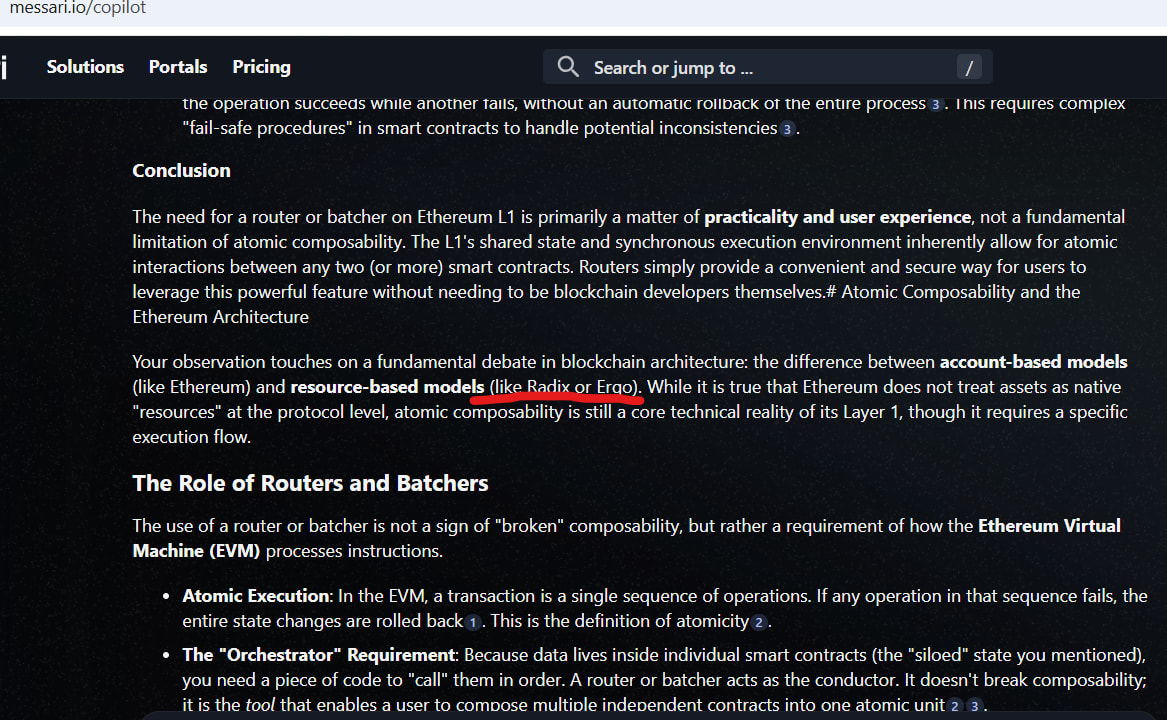
you can just simply chat with Messario.io for example to talk about composability on Ethereum, composability is possible only by using a router or a proxy dApp, in Radix it is very simple and anyone could arrange a TX by itself.

have a look also at its response

1 Like

that’s a strong angle, especially for dev-focused content.

the key difference i’ll push is:

on Ethereum → composability works, but requires routers/batchers and more complex execution flows

on Radix → composability is native and simpler, thanks to the resource-oriented model

i’ll translate this into simple dev-facing content like:

“why composability on ethereum needs extra layers”

“how radix simplifies multi-step defi transactions”

side-by-side examples (same flow: ethereum vs radix)

and short demos showing:

building a multi-step tx without routers

how assets behave as native resources

this way we’re not just stating differences, but making developers feel the friction vs simplicity.

i’ll incorporate this angle into the first creator briefs.