Member Requirements for DUNA (DAO membership)

I made a summary for all Nationalities with AI, so you know exactly what it means for you as a Radix DUNA member. In terms of anonymity, taxes, etc.


:classical_building: Summary: Member Requirements for a Wyoming DUNA

“What does joining this DUNA mean for me legally and financially?”

A Wyoming DUNA (Decentralized Unincorporated Nonprofit Association) is a legal shell that wraps the DAO to protect individual members from liability. Below is the breakdown of what is required from you based on where you live.

  • General Rule: If you are a standard member (holding tokens, voting occasionally, not an admin), you have zero registration duties.

  • Privacy: The list of members is NOT public. Only the “Registered Agent” (our US contact) is listed on public state records.


:united_states: 1. US Citizens / Residents

  • Legal Status: You are a member of a US non-profit association.

  • Liability: Protected. You generally cannot be sued personally for the DAO’s actions.

  • Taxes (IRS):

    • Holding/Voting: No tax event. You do not file anything.

    • Getting Paid: If the DAO pays you (grant/salary), it is taxable income. You must provide a W-9 form to the DAO.

  • Reporting (FinCEN):

    • Standard Member (<25% tokens): No reporting required.

    • Whale (≥25% tokens) OR Admin (Multisig Signer): You must file a Beneficial Ownership Information (BOI) report with FinCEN (requires uploading your Driver’s License/ID).

:european_union: 2. EU Citizens

  • Legal Status: You are a foreign member of a US entity.

  • Liability: Protected. Your personal assets in Europe are shielded from US lawsuits against the DAO.

  • Taxes:

    • Holding/Voting: No US tax filing required.

    • Getting Paid: If the DAO pays you, the US Government requires the DAO to withhold 30% of the money for taxes unless you file Form W-8BEN (which claims a lower rate based on your country’s treaty with the US). You then report this income in your home country.

  • Reporting (FinCEN):

    • Standard Member: No reporting.

    • Whale/Admin: Must file a BOI report with FinCEN (requires uploading your Passport).

:globe_showing_asia_australia: 3. Rest of World (Non-Sanctioned)

  • Legal Status: Same as EU citizens.

  • Liability: Protected.

  • Taxes:

    • Getting Paid: 30% US withholding tax applies automatically. You must file W-8BEN to reduce this if your country has a tax treaty with the USA. If your country has no treaty, you lose that 30% to the IRS.
  • Reporting: Same as EU (Standard members = Anonymous; Whales/Admins = Must ID to FinCEN).

:prohibited: 4. Banned / Sanctioned Jurisdictions

(Includes: Cuba, Iran, North Korea, Syria, Russia, certain regions of Ukraine, and others on the OFAC list)*

  • Can you join? NO.

  • Legal Risk: Because the DUNA is a US entity, it is illegal for it to provide services to, or send funds to, individuals in OFAC-sanctioned jurisdictions.

  • Consequence: If you are from these regions, you cannot legally receive grants or hold governance power without putting the entire DAO at risk of US federal criminal charges.


:warning: Summary Checklist for Members

Your Role Do you need to KYC? Do you pay US Taxes? Can you be sued?
Standard Member NO NO (unless paid) NO (Protected)
Token Whale (≥25%) YES (Private report to US Gov) NO (unless paid) NO (Protected)
Multisig Signer YES (Private report to US Gov) NO (unless paid) NO (Protected)
Grant Receiver YES (W-8BEN / W-9 Form) YES (Income Tax) NO (Protected)

Disclaimer: This is an educational summary, not legal advice. DAO members should always consult their own local tax professionals.
7 Likes

Dude! You rock! Thanks for putting this out there.

Curious question on the following:
Whale (≥25% tokens) OR Admin (Multisig Signer): You must file a Beneficial Ownership Information (BOI) report with FinCEN (requires uploading your Driver’s License/ID).

Where did you find the info on the Admin (Multisig Signer) needing to provide that info to the govt?

I knew about the ≥25% tokens part for Whales, but not the Admin part.

Point me to a link so I can be better educated.

Thanks again!

1 Like

This rule comes from the Federal Level, not state level, and therefore comes from FinCen as requirement. You can download on the link below the PDF (english ver.) page 16.

Clarification on Multisig Signers & Admin Reporting The requirement to KYC/Report doesn’t just apply to token whales (≥25%); it applies to anyone with “Substantial Control.”

According to FinCEN’s official guide (Chapter 2.3), “Substantial Control” includes anyone who has authority over “major expenditures or investments” or the “transfer of any principal assets.”

Since Multisig signers hold the keys to the treasury and are the only ones who can technically approve the transfer of funds, they meet the federal definition of “Substantial Control” and must file a BOI report.

Source: FinCEN Small Entity Compliance Guide (Page 16-18)

1 Like

Perfect! Thank you for the detailed response!

1 Like

I’m sure I’ll get more info from Cowie once we engage with them, but this part of the document you provided might be a reason we could potentially be exempt:

Document:

From Page 2:
The Reporting Rule requires that all “reporting companies” file BOI reports with FinCEN
within the previously specified time frames. A reporting company is any entity that meets the
“reporting company” definition and does not qualify for an exemption

From Page 11:

I don’t think we qualify for exemption. I put the PDF through Gemini Pro and from what I understand only if you are a Charity declared with IRS, but that is not going to happen with basically any crypto project. 1% chance to declare you Crypto Charity :)))

see below explanation and categories why you might think you fit, but you don’t actually:

Based on the official FinCEN Small Entity Compliance Guide you linked, the short answer is no, a standard Wyoming DUNA is not automatically exempt from filing.

While there is a theoretical possibility, in practice, a DUNA formed for a DAO (like a Radix community project) will almost certainly fail to meet the strict criteria for the exemptions listed in the document.

Here is the analysis of the three exemptions you might be hoping for, and why the DUNA likely does not qualify for them.

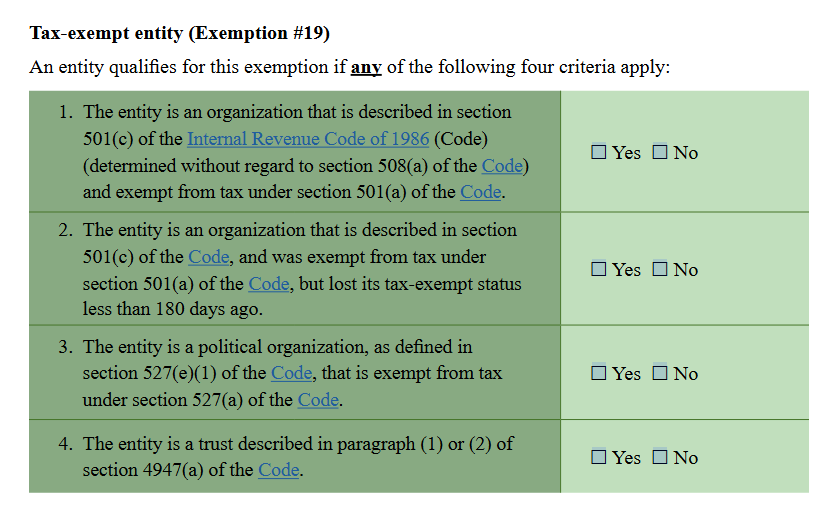
1. The “Nonprofit” Confusion (Exemption #19)

This is the most common misunderstanding. You might think, “My DUNA is a ‘Nonprofit Association,’ so I am exempt under Exemption #19.”

Why it fails: According to Page 18 (Exemption #19) of the guide, to qualify as a “Tax-exempt entity,” the entity must be:

  • “an organization that is described in section 501(c) of the Internal Revenue Code… and exempt from tax under section 501(a).”

The Reality:

  • State vs. Federal: Your DUNA is a “nonprofit” at the Wyoming State level. It is NOT automatically a “tax-exempt entity” at the Federal (IRS) level.

  • The Requirement: Unless your DAO has gone through the rigorous process of applying to the IRS for 501(c)(3) status (and receiving a determination letter), you do not meet Exemption #19. As we discussed, most DAOs are taxed as C-Corps (21% tax), which confirms they are not tax-exempt.

2. The “Inactive Entity” Loophole (Exemption #23)

You might think, “We haven’t done anything yet, maybe we are ‘inactive’?”

Why it fails: According to Page 21 (Exemption #23), an “Inactive entity” must meet all six criteria, including:

  1. “The entity was in existence on or before January 1, 2020.”

  2. “The entity is not owned by a foreign person.”

The Reality:

  • New Law: The Wyoming DUNA Act (SF0050) was passed in 2024. Any DUNA formed under this act is too new to qualify for this exemption.

  • Foreign Members: If you (an EU citizen) hold tokens, the entity fails the “not owned by a foreign person” test.

3. The “Large Company” Exemption (Exemption #21)

This exemption exists to spare massive corporations from paperwork, but it has physical requirements.

Why it fails: According to Page 19 (Exemption #21), a “Large operating company” must have:

More than 20 full-time employees employed in the United States.

  1. An operating presence at a physical office within the United States (owned or leased) .

The Reality:

  • DAOs are decentralized. They rarely have a physical US headquarters or 20 W-2 employees.

Summary Verdict

According to the document you provided:

  • Is it possible? Yes, if you get IRS 501(c)(3) charity status (Exemption #19).

  • Is it likely? No. For 99% of crypto DAOs, none of the 23 exemptions apply.

1 Like

Plus the DUNA entity still has to pay 21% IRS tax from what I see, on the treasury profits, etc, if it goes up. It’s just that it is not passed to the Members.

here’s also a comparison table with the other 3 best jurisdictions.

Marshall Islands seem to be more for Privacy for Directors, in the sense you don’t file with FinCen, etc. But they cost way more annually.

The Marshall Islands (DAO LLC)

Best For: Privacy & Ease of Setup This is the closest direct competitor to Wyoming. The Marshall Islands (RMI) created a specific “DAO LLC” law that is very popular.

  • Pros:

    • No Member KYC: Unlike the US, the RMI does not require a federal database of your members or admins.

    • Full Limited Liability: Same protection as Wyoming.

    • Tax-Free: If structured correctly, the entity pays 0% corporate tax in RMI (though you still owe tax in your home country).

    • Fast: Can often be set up in 1-2 weeks.

  • Cons:

    • Banking Difficulty: It is much harder to open a bank account with a Marshall Islands entity than a US entity.

    • Cost: Setup is usually $5,000–$10,000 (managed by MIDAO), which is more expensive than Wyoming’s $100 filing fee.

Summary Comparison Table

Feature :united_states: Wyoming DUNA :marshall_islands: Marshall Islands :cayman_islands: Cayman Foundation :switzerland: Swiss Association
Setup Cost Low (~$500-$1k) Medium (~$5k) High ($20k+) Medium ($5k-$10k)
Time to Setup Fast (Days) Fast (Weeks) Slow (Months) Fast (Weeks)
Privacy Low (US Gov Reporting) High (No Public KYC) Medium (Director KYC) Medium
Banking Easy (US Banks) Hard Medium Medium
Tax (Entity) Corporate Tax (21%) 0% 0% Varies (Low)
Best For… Protecting Members Privacy / Speed Token Sales / VCs Reputation

Recommendation

  • Stick with Wyoming DUNA if: You are a community DAO with limited budget, you want to protect members from lawsuits, and you don’t mind the US “Admin” reporting requirement.

  • Switch to Marshall Islands if: You absolutely refuse to send your ID to the US government (FinCEN) and are willing to pay a few thousand dollars for that privacy.

  • Switch to Cayman if: You are launching a massive token sale and need to handle millions of dollars in VC funding.

1 Like

Thanks for the info.
Yeah, the 21% shouldn’t be too burdensome since we don’t plan on having much “income” per se for a while at least. Changes in asset values (i.e. holdings of XRD) don’t cause a tax event unless they are sold.

1 Like

Also just as an idea, to compare with the current Jersey foundation, the costs and differences. Jersey seems more expensive but more institutional. Since it already exists, we cut costs to make it, we need just maintenance, but still high annually: 20k.

Privacy wise seems good also, just the Guardian, aka Andy in our case I think and board, are registered with Gov.

Jersey is a “premium” jurisdiction. If Wyoming is the “DIY / Community” option and the Marshall Islands is the “Privacy” option, Jersey is the “Institutional / High-Reputation” option.

It does not have a specific “DAO Law” like Wyoming or the Marshall Islands. Instead, it uses a Jersey Foundation as a “legal wrapper.” This is a mature, highly respected structure often used by major protocols (like dYdX or various Ethereum Foundation layers) that need to interact with European banks or regulators.

Here is the breakdown of costs, structure, and how it compares to your other options.

1. The Costs (The “Qualified Member” Trap)

The government fees in Jersey are low, but the professional fees are very high.

Unlike Wyoming, you generally cannot manage a Jersey Foundation yourself. The law requires you to appoint a “Qualified Member” to the Foundation’s Council (board).1 This must be a licensed Jersey corporate service provider (a regulated firm).

  • Setup Costs: ~£3,000 – £5,000 (Legal + Setup fees).

  • Annual Maintenance: £12,000 – £16,000+ per year.

    • This is the big difference. You are paying a salary to a regulated Jersey firm to sit on your council and handle compliance.
  • Government Fees:

    • Incorporation: ~£200–£820 (one-off).2

    • Annual Fee: ~£330–£1,010 (paid to registry).

Verdict on Cost: It is roughly 50x more expensive than a Wyoming DUNA ($100/year) and 2x more expensive than the Marshall Islands (~$5k–$10k/year).

2. The Structure: The “Orphan” Entity3

Jersey Foundations are excellent for DAOs because they are “Ownerless” (Orphan) entities. 4

  • No Shareholders: The Foundation has no owners.5 It exists solely to fulfill a purpose (e.g., “to develop the Protocol”).

  • The Council: This acts like a Board of Directors.6 It must include the “Qualified Member” (the service provider mentioned above). 7

  • The Guardian: This is a unique role.8 The Guardian’s job is to ensure the Council sticks to the “Charter.” In a DAO context, the “Guardian” can be the token holders (via a smart contract mechanism), effectively giving the DAO veto power over the Council.

3. Comparison: Jersey vs. Wyoming vs. Marshall Islands

Feature :jersey: Jersey (Foundation) :united_states: Wyoming (DUNA) :marshall_islands: Marshall Islands (DAO LLC)
Legal Status “Wrapper” (Traditional entity wrapping a DAO) “Native” (The DAO is the legal entity) “Native” (The DAO is the legal entity)
Setup Cost High (~$5k) Low (~$100 DIY) Medium (~$5k)
Annual Cost Very High ($15k - $20k+) due to mandated service providers Low ($100 + Agent fee) Medium ($5k - $10k)
Privacy Medium. Private register of beneficial owners (filed with gov, not public). Low. US Gov (FinCEN) reporting required for admins/whales. High. No central registry of members.
Liability High. Strong, tested corporate veil. High. Strong statutory protection. High. Modeled on US LLC law.
Taxes 0% Corporate Tax (Tax Neutral). 21% Corporate Tax (unless 501c3). 0% Corporate Tax (Tax Free).
Banking Medium/Good. Respectable for EU/UK banks. Good (US Banks). Hard. Banks view it as “high risk.”
Best For… VC-backed projects needing high reputation & banking. Community DAOs needing a cheap, legal shield. Privacy-focused DAOs wanting to avoid US/EU nexus.

4. Why choose Jersey? (The “Vibe” Check)

You choose Jersey if you are building a “serious,” well-funded protocol that needs to interact with the traditional financial world in Europe.

  • Reputation: Jersey is a “Tier 1” offshore jurisdiction. It is not seen as a “banana republic” tax haven. Having a Jersey Foundation signals to investors and regulators that you are compliant.

  • Economic Substance: Be careful. Jersey has “Economic Substance” laws.9 If your Foundation is generating income from IP or financing, the Jersey regulator may require you to have real employees and an office in Jersey. This can be a headache for a purely digital DAO.

  • VASP Regulation: If your Foundation actively exchanges tokens or acts as a custodian, it might need to register as a “Virtual Asset Service Provider” (VASP), which adds more compliance costs.

Summary Recommendation

  • Stick to Wyoming DUNA if: You have a low budget, want to get started fast, and just need “legal personhood” to sign contracts or protect members.

  • Look at Marshall Islands if: You have a budget (~$10k) but your main priority is privacy and avoiding the US/EU regulatory net.

  • Go to Jersey if: You are raising millions from VCs, need a “gold-standard” entity, and can afford $20k/year to pay professionals to handle compliance for you.

1 Like

Dude! This is an awesome summary (again)!

Yeah, I hadn’t researched the Jersey costs, but intuitively I expected them to be very costly. This just confirms my suspicion. Thanks again!

1 Like

Cayman Islands: The “Modern Gold Standard” by your favorite LLM

If Jersey is the “Institutional” choice, Cayman is the “Tech-Forward” equivalent. It is currently the most popular jurisdiction for high-value DAOs (like SushiSwap or ApeCoin) because its Foundation Company was specifically designed to be flexible for decentralized projects.

  • Structure: It uses a Foundation Company (FC). Like Jersey, it is “orphan” (no shareholders), but the law is much more flexible regarding how a DAO can “control” the foundation via smart contracts.

  • Costs:

    • Setup: ~$6,000 – $8,000 (Legal + Government fees).

    • Annual Maintenance: ~$5,000 – $7,000.

    • Comparison: It’s cheaper than Jersey because you don’t always need a “Qualified Member” from a regulated firm on your board (though you do need a local Secretary).

  • Privacy: High. There is a private register of directors/members, but it is not public.

  • Best For: Projects that want the “Premium” reputation of Jersey but at roughly 1/3 of the annual cost.

1 Like

Malta: The “Regulated EU Gateway” to avoid based on your favorite LLM

Malta styled itself as the “Blockchain Island,” but it has shifted toward a heavy regulatory focus. With the EU’s MiCA (Markets in Crypto-Assets) and DAC8 tax reporting rules fully active in 2026, Malta is no longer a “light” or “DIY” option.

  • Structure: Usually involves a VFA (Virtual Financial Asset) framework. It requires a specific legal person to be responsible for the DAO’s actions in the eyes of the MFSA (Malta Financial Services Authority).

  • The “Compliance” Heavyweight:

    • DAC8 Impact: As of Jan 1, 2026, any entity in Malta must collect and report detailed data on token holders to tax authorities if they provide services to EU citizens.

    • VFA Agent: You used to be forced to hire a “VFA Agent” (expensive middleman), but recent 2024/2025 updates allow direct application to the regulator—however, the compliance burden remains massive.

  • Costs:

    • Setup: €10,000+ (Legal fees + VFA application) .

    • Annual Maintenance: €15,000 – €25,000+ (Compliance officers, auditing, and regulatory fees).

  • Best For: Highly centralized “DAOs” that are actually acting as exchanges or custodial service providers and need an EU passport to operate legally across Europe.

1 Like

I’ll have to get the info on Própera ZEDE in Honduras in here, I posted everuthing I checked back then in TG :sweat_smile:

But I also posted a lot of checks for a lot of juristictions, god damn it.
I hate Tg … but I’m also not in love with RT :-p

Reading through this whole chain generally, and understanding that I am absolutely in favor of the Wyoming DUNA, I do think there is greater privacy risk in the U.S. than is otherwise indicated by the comments here. Most of the comments here focus on the BOI and reporting for whales/admins. As I understand it though, the DUNA will be allocating / spending funds and “paying” people. To do that in the U.S., you need to collect W-9s / W-8s and issue 1099s or equivalent documents. While those aren’t available to the general public, they’re certainly available to the IRS and government agencies. Anyway, that doesn’t bother me in the least, but I think it’s important to note as people contending for allocations of funds from the DUNA may not love this requirement if they truly want to stay “anonymous vis-a-vis the government.”

Today it’s very hard for a developer to launch his DeFi project because all of the compliance and legal staff.

Can the proposed organizations be an umbrella for people wanting to launch a project on Radix?

It could potentially be a regulatory shield if the project is setup as a subsidiary of the new entity.

That doesn’t mean it wouldn’t be able to generate a profit, but it would require the project to be structured that it enables the furtherance of the non-profit’s purpose.

For simplicity’s sake, these would be more “common purpose” projects that would benefit the network overall vs. one that would potentially compete with similar projects. Example: a proposed new DEX project would compete with existing DEXs e.g. Oci, DefiPlaza…etc. so this would be a competitive project and thus wouldn’t align with the goal of “furthering the DUNA’s common nonprofit purpose, such as supporting the development or maintenance of an open-source protocol.”

However, creating a set of tools for using, analyzing, new user on-boarding, or maximizing the usage of the network would fall under that definition and therefore could be partnered (and protected) by the legal structure if the project was willing to be beholden to the community governance process.

Want to point something out here. I actually don’t think 501(c)(3) is the exemption we want to apply for. More likely, it will be 501(c)(6). A (c)(3) is a public charity model aimed at charitable, educational or scientific purposes. It offers tax deductible donations (which I don’t think matters because Radix isn’t planning to be funded by donations), but it comes with some tight restrictions and a lot of scrutiny if it benefits a specific protocol or token holder base. For some DAOs that fund open-source research and broad public education that may make sense, but I don’t think it’s us. A (c)(6) is a “business league” that exists to promote the common business interests of a line of business or industry - i.e. ecosystems, developers, validators, etc. That feels like what the DUNA is doing. Donations aren’t tax deductible (but again, who cares), but a (c)(6) has a lot more latitude for member-serving activities like grantmaking that benefits a specific ecosystem. Uniswap went this route (and, less relevant, so did the Bitcoin Foundation).

1 Like