RFC - The Future of the Validator Subsidy & Pseudo Jailing

The Radix Foundation Validator Subsidy is intended to level the playing field for all node runners and ensure a baseline compensation is available to subsidise the costs of running server infrastructure. With the current Foundation preparing to handover operations to the community, there is an opportunity to reconsider how the node runner subsidy is managed.

The aim of this proposal is to achieve the following objectives:

  1. To remove the dependency on the current Radix Foundation to administer the subsidy.

  2. To propose a revised validator subsidy that tapers down over time to both extend runway and minimise validators’ dependency on it as we move to a more sustainable means of incentivising validators.

  3. To adjust the subsidy payment to account for both validator uptime and stake weight.

  4. To promote the use of validator fees and encourage stake rebalancing across the validator set.

  5. To make the receipt of the subsidy contingent on validators opting-in for a pseudo-jailing process to ensure high performance and network health.

Existing subsidy terms for reference:

Validators who KYC’d with the Radix Foundation were eligible to receive a subsidy of $500pm (paid in XRD) which is adjusted for uptime. The subsidy tapers linearly from 100% for 100% uptime, to 0% for 98% uptime.

This new proposal can be considered in two phases as follows:

Phase 1

  • The existing Radix Foundation commits to administering the subsidy for a period of 3 months (covering January to March with a final subsidy payment sent in early April). The amount is to be the lesser of 400,000 XRD or $500 worth of XRD, for each of the three transition months (assuming 100% uptime).

This minimises price sensitivity during the transition and caps XRD outflow in the event there is a significant price shock to the downside. This 3 month period is intended to provide time for validators to prepare for phase 2.

Phase 2

  • The administration of the subsidy moves to the new community entity.

The subsidy begins to taper aggressively over a period of 9 months from month 4 onwards, as per table 1 below. After 12 months the Radix community should decide whether to continue or cease the subsidy entirely.
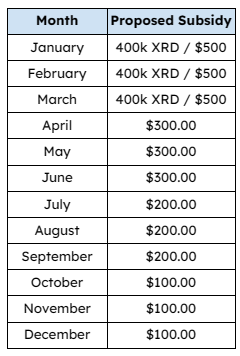
Table 1

A small amount of administration will be needed to calculate subsidies each month and a monthly transparency report published. This could be covered via a small stipend to be agreed by the community.

  • The subsidy is adjusted for uptime (as per the existing policy) and also stake weight, by assuming a 15% fee is set by all validators.

This is not a mandatory fee, but is used for calculation purposes to promote the use of higher fees for high staked validators. The aim is to encourage unstaking from these nodes and progressively move towards a median stake weight of 1% in the validator set. (Note, this correction will only apply after phase 2, the remaining subsidy payments administered by the current Foundation will not be affected). The impact of this correction can be seen in Table 2 below:
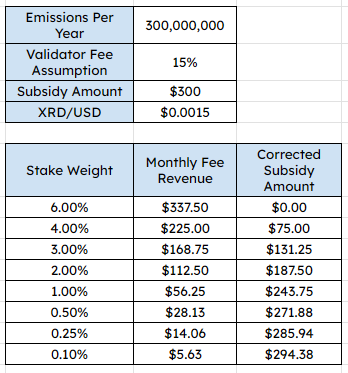
Table 2

The current subsidy correctly accounts for uptime, but does not consider the different economic realities of nodes at different stake levels. The approach above weights the subsidy in favour of nodes with less stake. These nodes incur similar costs, but are less able to cover them through fees. The effect being that nodes with higher stake have a greater incentive to increase their fees.

For a validator with more than around 5% stake, no subsidy would be awarded at all, with values increasing progressively and inversely proportional to stake weight. A highly staked validator is therefore encouraged to raise fees to make up the difference lost by the calculation. It is worth highlighting here, the effect on stakers’ APY in the event a validator increases their fees to 10 or even 15%. Below is an example:

Validator A has a 0% fee and 100% uptime. The APY their stakers earn is 7%

Validator B has a 2% fee and 100% uptime. The APY their stakers earn is 6.84%

Validator C has a 15% fee and 100% uptime. The APY their stakers earn is 5.95%

Whilst the fee increase appears significant, the effect on stakers APY is minimal, with only 1.05% difference in annual yield, despite a 15% increase in validator fees.

Over time, the intention is for this fee mechanism to contribute to stake rebalancing, as stakers will be encouraged to move to validators lower down the set with lower fees. This is healthy for decentralisation and allows the network to become more self-sustaining over time.

If this stake rebalancing effort is successful, an average stake of ~1% across the set will facilitate the end of the subsidy altogether, to a model whereby nodes are incentivised by fees alone. This can also be supplemented by an upgrade to the XRD price on chain (to be considered in a separate proposal) so that transaction fees are brought more inline with the current price, directly benefiting validators.

  • The subsidy payments should also be contingent on validators opting-in to a pseudo-jailing mechanism which is described below:

Pseudo-Jailing

Jailing is the term used to describe the action of excluding top 100 validators from taking part in consensus. In the current network, if a validator is offline, suffers high latency or some other network issue, they may not be able to propose the state of the network when called up to do so. As a result the liveness of the network is affected. The impact of this is dependent on the amount of stake carried by validator(s) experiencing the downtime.

Generally the network performs well, and whilst there are currently a handful of validators who are registered for consensus but offline, the effect is negligible as they don’t carry a lot of stake.

One concern for example would be if a cloud provider (take Hetzner for example) decides that validating on Radix breaches their terms. They could theoretically switch off up to 30% of the network overnight. If such an event was to occur, individual validators would be required to unregister or migrate to backup servers to prevent the network halting. In order to limit downtime in such an event, jailing can be implemented which performs the job of unregistering nodes to ensure the network can continue to function.

Ideally this would be implemented at the protocol level, requiring an upgrade to the node software. However, given the importance and criticality of this feature, this proposal suggests an interim solution that can be implemented without any node upgrade.

Some of the validator/node runners already utilise an access manager component which allows them to deposit their owner badge (which has ultimate control of the validator component) and mint multiple admin badges. The original intention for this component was to allow validator teams to collectively take responsibility for a validator or to delegate responsibility to a third party (by enabling anyone with an admin badge to call methods such as “unregister” or “update fee”).

The proposal is to enhance the access manager component with a jailing feature that would automatically be opted-in to, but could be opted-out at the discretion of the validator/node runner.

With the “jailing” feature enabled, this would authorise a validator/community committee to call the unregister method on the validator subject to certain conditions being met. This committee would be able to vote on whether a node should be unregistered, based on a minimum stake weight (TBD) and a number of voting participants (TBD). Once the threshold is met, the committee would be able to force the unregister method to be called on the validator, and potentially lock the component for a period of time.

This approach is not enforced by the network itself and would not require any upgrade to the node software. It is intended to serve as an interim solution for ensuring that poor performing validators can be removed to preserve network function and liveness.

The challenge comes from ensuring that enough validators opt-in to deposit their owner badge into the access manager component. It is therefore suggested that if implemented, receipt of the subsidy be made on the condition of a validator opting in to this process. Provided 70%+ of stake agrees to be bound by this pseudo-jailing process, network liveness can be safeguarded until an automated process can be implemented at the protocol level.

8 Likes

Great write up! Is the timeline of this RFC based on:

  • time needed to transfer assets from foundation to new entity
  • time needed to code psudo-jailing into access manager component

Is the year long ramp down of subsidies based on needing a year to button up one’s validator setup to handle the drop is subsidy income?

i like A lot these approach specially on the jailing area.

1 Like

Thanks Jon.

The 3 month period of phase 1 gives time for the new entity to be setup with minimal disruption to the existing subsidy.

The psuedo jailing element of the proposal is supplementary, the changes to the subsidy could happen regardless and the jailing could be added at a later date. I have a community member lined up to do to the work on the jailing component if required, but there are a lot of questions to answer on that such as: how many people should be in the committee that can vote to unregister a node? Should this be a stake weighted vote and on what terms? etc.

The year long ramp down could certainly be shortened. It’s mainly to allow time for the stake rebalancing to take effect. If we can get the set closer to a median of 1% stake then it’s a much more level playing field for free market forces to take over.

1 Like

Only one issue:

what if we don’t get the new entity up and valid in due time? It’s all voided? The FND continues as it’s still operating?

II rather we would go for full sunsetting of the subsidy, period. No more subsidies.
And yes, to be clear, I’m a validator owner and runner and I am a recipient of the current subsidy.

And I have always operated by node with a 6% fee, whilst everyone else but a few exceptions is lower.

Can’t we just get a consensus on full stop of it, pls? It would make everything so much easier …

I am weary about handing over the network’s security into the hands of a small group of validator administrators that can unregister validators at will.. assuming most validators will not opt-out because they need the subsidy.

I know from experience running the DefiPlaza Treasury multisig on Ethereum how hard it is to get 5 out of 7 people to sign a transaction, let alone more.

6 Likes

what if we don’t get the new entity up and valid in due time? It’s all voided? The FND continues as it’s still operating?

In this case I would suggest that the subsidy ends at the end of March. That may be sufficient time for validators to prepare accordingly and for new node runners to consider setting up. Personally I think the network is too fragile for a sudden stop.

1 Like

Why can’t we cap the % staked to a single validator at 1%?

It seems tricky to try and use to the subsidy to try and sway the validator fee and the overall stake % per validator.

An idea would be to go into the validator node software and add jailing and a % cap on how much stake can go to a single validator.

I like this proposal, the timings are right

Just one perplexity: Caviarnine used to cut out of the LSU pool validators with high fees.
Being excluded from the LSU pool is not nice.

Do we know if there’s a precise threshold for being in the LSU pool?

The real issue is that the validator set being 100 is an artificial cap because Babylon is not sharded!
Not even Dan was really strong at supporting the number - easiness was the main factor, iirc, and it needed enough of a number to enable a good nakamoto coefficient.

We can’t keep that limit in Xi’an, as each shard needs a strong and capable validator set.

In fact, with Xi’an, we need an army of validators ready to be spun up in case there’s the need, else we either won’t have enough to run it or the existing validators end up serving all shards and won’t be able to keep up with it (or become behemoths that cost stupid :sweat_smile: )

So, the sooner we all let go of any artificial caps or gimmicks on running the network, the sooner we’ll be ready for Xi’an.
Xi’an will require K’s of validators, incentives can’t come from deterministic/arbitrary and artificial sources, they’ll have to be natural dynamics from the network’s necessities!

5 Likes

I like this. How do we position ourselves to be ready for Xian?

If Fox is done in 6 months but the current validator group is comfortable with how things are is going to a Xian setup going to be eve more shocking?

I agree that we will need lots more validators for Xi’an, but the incentives for people to run nodes won’t just come naturally if we stop the subsidy.

The network is too centralized as it is, with the top 50 having 85% of the entire network stake. If we were to end the subsidy without working on a way of addressing this imbalance, I predict that stake will just gravitate further to the top nodes who can afford to run on fees alone.

1 Like

Thanks for raising the topic Faraz, this is very timely as we will need to find a way to deal with Foundation discontinuing the subsidy sooner rather than later. Your proposal is quite detailed and shows significant thought went into it, which is good. It’s clear that something needs to be done, but I don’t fully align with this proposal and will share my reasoning below.

  • Network subsidy and validator jailing are two very different problems. I think they should be approached independently. As a matter of principle (decentralization first and foremost!) I oppose pseudo-jailing. Robustness against offline validators needs to be part of the node software, independent of human coordination. This deserves its own thread. In the below I’ll just discuss the subsidy part of the proposal.
  • I’ve never liked the subsidy construct. It’s a shortcut that kicks the can down the road. And it only works when XRD price is strong. The underlying assumption seems to have been that if prices would fall this low, the project is failed anyway and it no longer matters. I disagree with that perspective entirely.

In my opinion we should really consider is if the overal supply / demand picture. For example, with BTC the profitability of mining is directly anchored to the BTC price and the hashing power already deployed to sustaining the network through the PoW mechanism. Node income is inherently no larger or smaller than what the network can sustain at a predetermined inflation level.

This is my core issue with our network subsidy, it distributes tokens independently of what the network can sustain. With current prices, that distribution is way too much pushing us ever deeper into misery. It’s not great, but in order for Radix to succeed long term, I believe we need to stop flooding the network with subsidy tokens f it there is insufficient demand for XRD.

In my opinion, the only sustainable way for node rewards is to bake them into the staking rewards. The node fee is one part of that, but we cannot rely on just a flat fee as that means the nodes with the most stake can run the lowest fees, making them attract even more stake and creating a lopsided distribution. An underlying mechanism to assign part of the staking rewards (and transaction fees) to validator nodes in a way that encourages a smooth stake distribution should give us the best chance of success.

4 Likes

Thanks for your feedback Jazzer. I agree the 2 need splitting out into separate proposals, I just bundled them together for comments, as I wanted to make one contingent on the other.

If these progress into formal proposals they can be voted on independently.

I don’t disagree with anything you’re suggesting, but to design and implement such a mechanism is going to take considerable time. A better question to put to the community then should be, what do we do in the meantime?

The existing foundation is not going to continue administering the subsidy long term. I think 3 months is an acceptable compromise that gives them a deadline to work to and also gives validators time to plan accordingly.

Personally I feel a tapering of the subsidy is the right approach. Would you suggest a hard stop instead?

1 Like

Whether it is now or tapered down in a year, we should prepare for a time where the subsidy is gone altogether. I wouldn’t be surprised if we lose a ton of validators when that happens. So the sooner we look at implementing a node modification to cope with that the better.

No more subsidies.

No minimum fees.

No greedy nonsense.

The free market is the best way to solve matters.

I will not elaborate further.

3 Likes

Thanks to everyone for their comments and feedback so far. I think it will be useful to gauge from the community what the preference is in terms of duration of subsidy as well. Please respond to this poll with your preferences to help guide the proposal forward:

The same poll will be posted in the Radix Telegram (See Telegram Poll)

  • When Should the Validator Subsidy End?
  • Immediately
  • February 2026 (1 Month)
  • March 2026 (2 Months)
  • June 2026 (5 Months)
  • December 2026 (11 Months)
  • Keep Subsidy Indefinitely
0 voters

I would rather our network face bumpy times now because the subsidy ends vs facing bumpy times later when there are more eyes on us.

I think this whole discussion points to work needing to be done on the core node software.

I like using BTC as a gauge - the more hash power ones has the more likely they will earn more BTC.

How do we translate that to validators?

We don’t want to play czars of the network and hard code into the node software a given node can’t have more than X stake (I know I literally suggest that above ha) or must charge above Y fee.

If we had those “guards” the same entity could spin up another validator with the same incentives to gain a similar level of stake.

I have reread everything once again.

Here’s my current conviction:

let’s stop any and all subsidies now, the network’s usage demand is so low that it can’t really be hurt at this point, even if we loose a good chunk of nodes.

The other subjects being discussed are not subsidy-related, and are ofc important, but are not affected by it, imho.

There’s a simple technological solution to all we have been addressing:

1 - go PoS+PoW as Dan kept pointing at

2 - go Secure PoS as Foxy pointed out

2 Likes

The number of validators we have now is not aligned with the demand/usage, yes. However, it still matters for radix decentralized ethos and relevancy.

I dont think it’s a good optic If we lose too many validators at once because the fee stops. Several people have suggested to do a survey within validators to have an idea of how many validators we would lose if subsidiaries are stopped.

1 Like