Why the Wyoming DUNA would be a mistake; a better alternative proposed

First of all, I want to say that I appreciate Peachy stepping up to propose the Wyoming DUNA as an entity to succeed from the current Foundation (Radix Tokens Jersey Limited/RTJL).

I would like to give a few reasons why I believe incorporating in the US would be a big mistake:

  1. The SEC still believes most cryptocurrencies are securities, especially Layer 1 tokens. While they have been reined in somewhat, they are still a clear and present danger to all crypto projects incorporated in the US.
  2. Radix is not a US-centric project. Radix is a global project. Validators are worldwide. Less than 1% of the project’s investors are US citizens. We would basically be accepting SEC oversight over Radix with no compensatory upside.
  3. Radix is a neutral Layer One permissionless blockchain. The protocol must last decades and appear neutral. Incorporating in the US harms its neutrality, creates a US nexus, and Radix gains almost nothing from a US domicile.
  4. A DUNA becomes more expensive over time due to legal, tax, and compliance drag.
  5. A Wyoming DUNA doesn’t make it easier for US investors to buy Radix. In some ways it makes it harder. US-based hedge funds, VCs, and institutions do not buy based on entities being domiciled in the US. Otherwise, they wouldn’t be buying Solana, Ethereum, Sui, Aptos, etc., all of which are incorporated in the Cayman Islands. Such investors care primarily about liquidity, custody, and risk (exit risk, headline risk). A project being incorporated in the US adds very chunky risks due to enforcement possibility.

It is my belief that the Cayman Islands would be a much better fit for RTJL’s successor entity:

  1. Virtually every Layer One cryptocurrency uses Cayman for their Foundation. Examples: Ethereum Foundation, Solana Foundation, Polkadot Foundation, Avalanche Foundation, Aptos Foundation, Sui Foundation.
  2. Cayman is neutral, boring, and understood by regulators. Suited to projects with a global base of investors and significant treasuries.
  3. Cost: around $30–40k up front, around $10k a year. I have no idea how much money is left in RTJL; if this is unaffordable, the other option would be to register in Panama as a bridge until the XRD price can recover. But a Wyoming DUNA is significantly more expensive than Panama too. The good thing about Cayman is that the costs are relatively stable year-on-year, as opposed to the US where costs will rise every year, possibly by a lot.

I want to reiterate that I believe a DUNA would be an enormous mistake due to the reasons outlined above. That said, the decision belongs solely to you, the community. If you decide the DUNA is the best path forward, I will do everything to support it and help it to work.

I would welcome any thoughtful responses to the substance of what I have said.
1 Like

Responses below:

  1. The SEC still believes most cryptocurrencies are securities, especially Layer 1 tokens. While they have been reined in somewhat, they are still a clear and present danger to all crypto projects incorporated in the US.

The overwhelming and substantial majority of enforcement cases are due to “selling tokens” (i.e. ICOs) by the entity. We no longer have that issue as all of our tokens (excluding the staking emissions) are already in the hands of their respective owners. As such, token sales other than OTC offers from individuals (including the Foundation) are beyond the scope of their most notorious enforcement efforts. OTC and market sales are handled like any other asset sale.

  1. Radix is not a US-centric project. Radix is a global project. Validators are worldwide. Less than 1% of the project’s investors are US citizens. We would basically be accepting SEC oversight over Radix with no compensatory upside.

Putting the DAO in ANY location inherently, by it’s very definition, makes it centric to that location. Including The Cayman Islands. The SEC oversight argument is addressed in point #1.

  1. Radix is a neutral Layer One permissionless blockchain. The protocol must last decades and appear neutral. Incorporating in the US harms its neutrality, creates a US nexus, and Radix gains almost nothing from a US domicile.

I see little evidence from what you provided that it harms the neutrality of the network.

  1. A DUNA becomes more expensive over time due to legal, tax, and compliance drag.

Another opinion without substantive evidence.

  1. A Wyoming DUNA doesn’t make it easier for US investors to buy Radix. In some ways it makes it harder. US-based hedge funds, VCs, and institutions do not buy based on entities being domiciled in the US. Otherwise, they wouldn’t be buying Solana, Ethereum, Sui, Aptos, etc., all of which are incorporated in the Cayman Islands. Such investors care primarily about liquidity, custody, and risk (exit risk, headline risk). A project being incorporated in the US adds very chunky risks due to enforcement possibility.

I believe that being registered in the U.S. brings us more awareness to U.S. funding sources and VCs as well as locating in a country with a high talent population. Of course, these are merely my opinions so on that point we can agree to disagree. The liquidity and custody risks are not relevant to where the organization are HQ’d based on our current status (i.e. Non-ICO status).

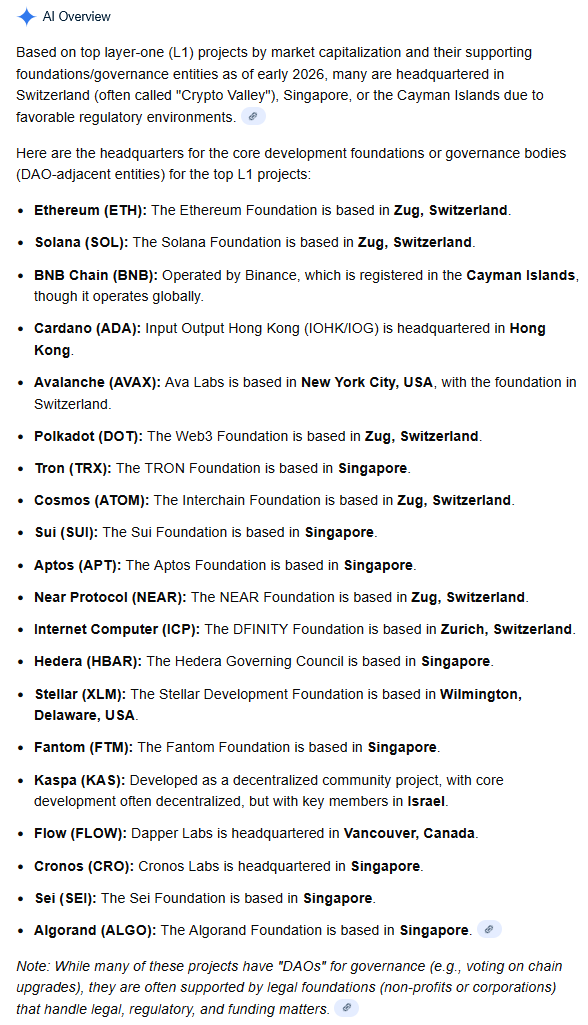
Regarding your statement about other projects and their DAO locations: You should check your facts around where various L1s are headquartered. Below is a simple search for “Where are the Top 20 crypto Layer One projects headquartered for their DAO”

Only 1 is HQ’d in Caymans: BNB chain.

It is my belief that the Cayman Islands would be a much better fit for RTJL’s successor entity:*

  1. Virtually every Layer One cryptocurrency uses Cayman for their Foundation. Examples: Ethereum Foundation, Solana Foundation, Polkadot Foundation, Avalanche Foundation, Aptos Foundation, Sui Foundation.

Incorrect. See AI output above.

  1. Cayman is neutral, boring, and understood by regulators. Suited to projects with a global base of investors and significant treasuries.

It also suffers from the perception issue globally of secrecy, tax avoidance and other nefarious activities (e.g. Panama Papers…etc). We want to promote transparency above all and with community governance vs. the Cayman model of electing a “board” or “council” that hopefully performs what we need them to do.

By going with the Cayman model we would effectively be trading one quasi-secretive actor (Jersey Foundation) for yet another one. Again, my opinion.

  1. Cost: around $30–40k up front, around $10k a year. I have no idea how much money is left in RTJL; if this is unaffordable, the other option would be to register in Panama as a bridge until the XRD price can recover. But a Wyoming DUNA is significantly more expensive than Panama too. The good thing about Cayman is that the costs are relatively stable year-on-year, as opposed to the US where costs will rise every year, possibly by a lot.

Not sure where you received your quotes from. I would like to verify those figures independently.

Your statement that the WY DUNA is significantly more expensive is not based on the facts available and published in countless examples and publications. I have no clue where you derived your opinion of these costs from so please share your source.

As for costs rising year over year in the US, that is also an unfounded statement of opinion. Please provide sources for your assumption.

Thanks!

1 Like

James, a few observations, I’ll elaborate further when possible:

1 . We can’t worry about the SEC anymore that we can about any other regulatory entity with oversight anywhere else; any solution will have regulatory issues to handle. These are not facts, just your perception of the US and the SEC.

  1. We will be accepting oversight from someone/somewhere regardless and always with potentially no benefits/compensation. And again your opinion on the US/SEC bleeding into this without any actual facts.
  2. The DUNA actually does not incorporate! That’s the main aspect it brings and why it completely shields every holder and even any “administrators” from any liability on a personal way. The DAO is the entity and the only entity to be held liable, so only the assets under the direct ownership of the DAO are of liability purview. It can sue and be sued, so litigation is available, but no natural persons nor their assets and property are at risk ever.
    we only ever risk whatever is under the DAO’s direct ownership and control.
    Did you read the DUNA’s docs in detail? This was discussed and referred to.
  3. Data/information to support this please? Else it’s just an opinion and no more valid than its contrary, sorry.
  4. In this I at least partially agree - it’s not liquid that it represents an advantage for capturing US investors, and that as been touted by some. But that’s not an actual goal of the DUNA, just what some associated with it and believe to be true. I’m more inclined to accept your opinion that it will not, in that specific regard. But, again, that’s not part of the base reasons to use a DUNA and doesn’t constitute a goal for the DUNA at all.

Re Cayman Islands

  1. Yes, they have a very good track record of being the choice of other crypto projects, notably those of greater dimension, success and importance in the whole space.
    But we know very little of what their rational was and what lead them to that choice, and, additionally, the DUNA wasn’t available to them back when they chose the Cayman for most (if not all) of them … and we know nothing of eventual plans they might have to change that either.
    It’s not disputed that this is a great support point for the Cayman, just not an absolute argument in favor of it, imho.
  2. I’ll take your wording for it, in this case, but again, it’s just a favorable look, not actual actionable arguments to consider. It’s a very neutral and boring affirmation, actually, pardon me the pun :sweat_smile:
  3. There’s a lot of speculation here on your part and no substantial data to support it, regarding costs you pin on every case - the costs being higher for the DUNA and the stability of the Cayman. I do not doubt (but also didn’t check) the actual costs you state for the Cayman … but I do not credit your afterward speculations on the rest.
    And although I’m not checking it as I type, I seem to recall that the costs for the DUNA were not more expensive than Pamana (witch btw you just cram in here out of the blue when comparing the DUNA with the Cayman, makes no sense) and certainly not “significantly more expensive” - again, where’s the ref and the data to support this?

I’ll grant you that apart from a few exceptional cases, most other arguments shown by others (in TG and also in here) were AI-sourced tables and info but at least the numbers are there and can be searched for, analyzed and validated using direct sources and publicly available information, should we have any doubts and/or want to fact checking.

You have an opinion and that’s good and ok and it merits the same respect as my own or anyone else’s … but I find your exposé lacking the substance and data/refs to be put to enough scrutiny for supporting an informed decision, just I find the very same about others, mind you. Even some of the info I gave to this falls under that and wouldn’t hold up to my own scrutiny :slight_smile:

Discussing opinions and speculative information is something that can be useful and important, but not anymore in the context of this subject, as I feel and argue that we really need to be looking into and compare actual validated and verifiable intel.

On another take, I’m glad to see you act on this and actually coming in here and creating the topic, as the TG arguments were kinda leading to useless confrontation and noise and are hardd to keep track of.

Thank you for doing that and giving others the opportunity to give you feedback in a more productive way, I hope - for me, that’s the case.

2 Likes

Peachy, you are correct that the SEC historically has focused on ICOs. However, that is far from the limit of the SEC’s jurisdiction. Ongoing coordination, protocol control, treasury management, or network influence by a US-domiciled entity can all cause an asset to be deemed a security and invite enforcement action.

Which you are basically asking for by incorporating in the US.

Yes, any legal wrapper creates a tie to that location. The difference is in risk asymmetry. The Cayman Islands are not going to be launching a crypto crackdown, that is virtually guaranteed. The US almost certainly will again at some point.

You like to say everything is my opinion, but everything I’ve said can be easily factually verified. Conversely, your claims that a US entity will encourage US investment is provably false.

Did you notice that on the list you sent me, there is NOT ONE Layer One Foundation domiciled in the US? Does that tell you something?

1. “We can’t worry about the SEC more than any other regulator”

I disagree. The SEC is categorically different from most other regulators because it uses enforcement-first interpretation and has demonstrated willingness to reinterpret settled assumptions retroactively. That combination is not mirrored by Cayman, Jersey, Panama, or most other jurisdictions commonly used for foundations. You’re right that some regulator will always have oversight. You’re wrong that all oversight is risk-equivalent.

2. “The DUNA does not incorporate; it shields individuals”

I have read the DUNA documentation. You are correct on limited liability within the Wyoming statutory framework:

  • No personal liability for members or administrators

  • DAO can sue and be sued

  • Liability limited to DAO-controlled assets

However, this does not eliminate:

  • Jurisdictional exposure

  • Discovery obligations

  • Injunctive relief

  • Asset freezes

  • Administrative coercion

Limited liability is not akin to regulatory insulation.

3. “Only DAO-owned assets are ever at risk”

The relevant question is not what can be seized, but:

  • What can be restricted

  • What can be ordered

  • What can be enjoined

  • What becomes toxic to counterparties

A DAO whose treasury is frozen, ordered to cease activity, or subject to prolonged litigation is functionally impaired even if no individual is harmed. That is the crux of the matter.

4. “Provide data, otherwise it’s just opinion”

  • Claim: SEC enforcement risk is higher for US-domiciled entities
    Status: Empirically supported by enforcement history

  • Claim: US regulatory scope is expanding, not contracting
    Status: Observable via statutory expansion (e.g., staking, DeFi, custody actions)

  • Claim: Cayman foundations experience lower enforcement volatility
    Status: Supported by absence of comparable retroactive enforcement

I agree that citing specific case law and filings would strengthen this and I can dig them up today if you’re interested. But the directionality of the risk is NOT speculative.

5. “US investor access is not a DUNA goal”

On this point, we largely agree. If US investor capture is not a core goal, then the primary justification for US domicile evaporates and the cost-benefit calculation shifts sharply toward risk minimization.

6. Cost speculation (DUNA vs Cayman vs Panama)

What I can say without any speculation:

  • US compliance costs are open-ended

  • Litigation exposure in the US is non-linear

  • Insurance and legal reserves must scale with enforcement climate

Cayman costs are:

  • More predictable

  • Less sensitive to political cycles

  • Structurally capped

Panama was mentioned as a cheap alternative if we couldn’t afford anything else, not a recommendation.

I believe US domicile introduces a qualitatively different class of long-tail risk that a protocol-stewarding entity should avoid unless there is clear, compensating upside. So far, I do not see that upside.

Peachy, you are correct that the SEC historically has focused on ICOs. However, that is far from the limit of the SEC’s jurisdiction. Ongoing coordination, protocol control, treasury management, or network influence by a US-domiciled entity can all cause an asset to be deemed a security and invite enforcement action.

Which you are basically asking for by incorporating in the US.

More conjecture and opinion. We agree to disagree.

Yes, any legal wrapper creates a tie to that location. The difference is in risk asymmetry. The Cayman Islands are not going to be launching a crypto crackdown, that is virtually guaranteed. The US almost certainly will again at some point.

More conjecture and opinion. We agree to disagree.

You like to say everything is my opinion, but everything I’ve said can be easily factually verified. Conversely, your claims that a US entity will encourage US investment is provably false.

I will wait patiently for you to provide that “factually verified” information (like how I factually verified that you were incorrect in your “assumption” for where the top projects are HQ’d.

Did you notice that on the list you sent me, there is NOT ONE Layer One Foundation domiciled in the US? Does that tell you something?

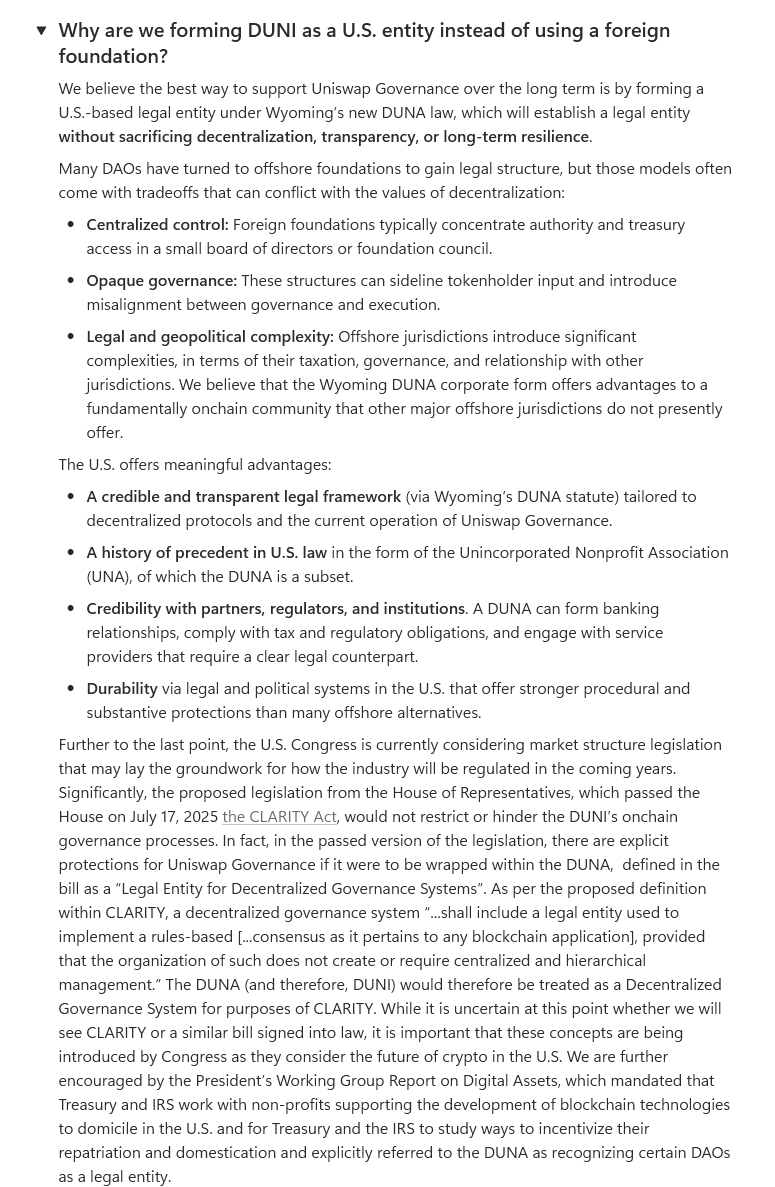
**As projectShift stated eloquently: additionally, the DUNA wasn’t available to them back when they chose the Cayman for most (if not all) of them … and we know nothing of eventual plans they might have to change that either.

The DUNA structure only recently became available.
Additionally, Uniswap did a significant amount of due diligenced on this topic as well. Their opinions on the topic mirror my exhaustive research as well.

You can read their reasoning on their governance FAQ:**

2 Likes

A Wyoming DUNA makes sense for Uniswap because Uniswap is already a US-centric project. It operates at US political scale, is already in regular contact with regulators and lawmakers, and is an obvious enforcement and policy target regardless of domicile. For Uniswap, a DUNA is a defensive move: it pulls an already-exposed protocol inside a familiar legal framework, improves day-to-day operability with banks and service providers, and positions the project to benefit if US DAO-specific legislation like CLARITY eventually lands. In that context, the additional exposure isn’t new risk so much as a formalisation of existing reality.

Radix is in a fundamentally different position. It is a Layer One rather than a dApp; global by design and in practice; not US-centric in investors, validators, governance or influence; and currently sits outside the US regulatory perimeter in any meaningful way. Adopting a US DUNA would not manage existing exposure; it would CREATE it. Needlessly. That would be a voluntary bet on long-term US regulatory and political stability with no clear compensating upside, especially given Radix’s multi-decade time horizon. For Radix, neutrality and distance reduce long-tail risk, whereas a US domicile trades that neutrality for operability benefits it does not actually need.

We won’t “agree to disagree” on propositions that are either true or false, we will go by the facts and reason things through as a community.

You can’t predict the future any more so than I can so we can agree to disagree is a valid response.

Not being able to predict the future is a poor rationale for adopting needless, chunky risks without compensatory upside.

No one can say for sure whether or not a certain piece of barren land filled with land mines will have a 7-Eleven built on the other side of the road in a few years, or whether oil will be discovered there. It doesn’t mean I should immediately buy that land.

Claiming the US system is fraught with landmines is rich coming from someone who was raised and matriculated in the UK.

Yet another example of a looking backwards at what has happened while ignoring the current climate and future opportunities that are being created and developed now. Where is that adventurous spirit that used to exist when the UK was the global superpower?

Ok. You’re letting your discourse degenerate now Peachy. This isn’t a slanging match between us anyway. I’d like to hear from some more members of the community.

1 Like

Regarding the US system today:

Crypto exposure in the U.S. hovers around 20% (with some estimates as high as 30%). As such, the tipping point has passed beyond it being a niche entity that can be easily governed into irrelevance and obscurity. There are too many entrenched players that own and care about it.

They are currently completing the structure to enable using btc for quasi-federally insured housing loans.

1 First they ignore you,
2. then they laugh at you,
3. then they fight you,
4. then you win

We are moving swiftly passed step 3 already.

Hi @James.xrd :waving_hand:

Could you share some articles that you’ve read that influenced your stance on Cayman?

I was thinking we could do a trade - I read material you share and you read material I share?

I read through this Notion and it was insightful regarding WY DUNA.

I look forward to reading what you share.

My stance has been rather more influenced by ongoing news coverage of the regulatory regime in the US. Contrary to popular belief, not much has changed there materially for crypto. Even if the CLARITY bill passes, the US will not become a crypto paradise — it’s an imperfect bill that leaves many pitfalls for crypto projects incorporated in the US. At the end of the day, you will still be registered in a high-risk territory if you do so in the US. With a regulator that is subject to mood swings and occasional bouts of aggressive enforcement.

Espousing a buccaneering attitude is admirable especially in a man of Peachy’s age. But it doesn’t alter the fact that the US is — and looks likely to remain for many more years — at best a highly complex and fraught jurisdiction for crypto.

Your first point about the SEC regarding layer 1 tokens is inaccurate.

Later one tokens are not securities as per the Ripple vs SEC

In short;

  • Institutional sales: XRP sales to hedge funds and institutional buyers were classified as unregistered securities offerings.

  • Programmatic sales: XRP sold on exchanges was not a security. Retail buyers had no expectation of profits from Ripple’s efforts.

SEC failed to apply the Howey test to the XRP token. In the same way, as a layer 1 token XRD is not sold on an exchange with the expectation of profit solely from the work Radix.

Legally XRD is safe. However….

As a footnote. It could be argued that the whole case was corruption defined, as Jay Claydon left the SEC the day after filing the case against Ripple and went to work in a law firm that worked with Etherium, arguably Ripples competitor. This. Coincided with Etherium mooning and XRP dumping ( because of its regulatory legality doubts) . I read with horror that Claydon has become a state attorney in the southern district of New York and hates Ripple . Is this crooked bastard still wanting to chew on a crypto bone? This worries me, but we probably don’t have time for these kind of worries / anticipatory fears right now.

I’m happy for the project to be based in the US on the basis that it IS legally safe in the US atm, as a layer 1 token if sold to public with no expectation of profit… as it is most definitely now. (How can anyone expect a profit when you look at the Radix chart would probably stand up in court as well!!:joy:)

1 Like

Well guys…

Don’t say I didn’t warn you.

Id also add that this project has been anchored by Britishness throughout its decline. Too much polite pondering before the SA80 is fired, not enough , annihilate the zone with a 30mm M230 Apache Gunship chain gun and ask questions after

And a big plus : Peachy attitude makes me feel that someone who believes in the project actually has a drive to plough it forward

5 Likes

Before reading all allegations on Cayman Vs Usa i still continue believe that Usa is a best aproach at these moment. Sorry but change Jersey “paradise” for Cayman one for me is a no way.

I am curious what would lead to greatly increased costs YoY for DUNA?

Sorry for ignorance, but does Cayman islands have real legal vehicle for DAO?