Responses below:
- The SEC still believes most cryptocurrencies are securities, especially Layer 1 tokens. While they have been reined in somewhat, they are still a clear and present danger to all crypto projects incorporated in the US.
The overwhelming and substantial majority of enforcement cases are due to “selling tokens” (i.e. ICOs) by the entity. We no longer have that issue as all of our tokens (excluding the staking emissions) are already in the hands of their respective owners. As such, token sales other than OTC offers from individuals (including the Foundation) are beyond the scope of their most notorious enforcement efforts. OTC and market sales are handled like any other asset sale.
- Radix is not a US-centric project. Radix is a global project. Validators are worldwide. Less than 1% of the project’s investors are US citizens. We would basically be accepting SEC oversight over Radix with no compensatory upside.
Putting the DAO in ANY location inherently, by it’s very definition, makes it centric to that location. Including The Cayman Islands. The SEC oversight argument is addressed in point #1.
- Radix is a neutral Layer One permissionless blockchain. The protocol must last decades and appear neutral. Incorporating in the US harms its neutrality, creates a US nexus, and Radix gains almost nothing from a US domicile.
I see little evidence from what you provided that it harms the neutrality of the network.
- A DUNA becomes more expensive over time due to legal, tax, and compliance drag.
Another opinion without substantive evidence.
- A Wyoming DUNA doesn’t make it easier for US investors to buy Radix. In some ways it makes it harder. US-based hedge funds, VCs, and institutions do not buy based on entities being domiciled in the US. Otherwise, they wouldn’t be buying Solana, Ethereum, Sui, Aptos, etc., all of which are incorporated in the Cayman Islands. Such investors care primarily about liquidity, custody, and risk (exit risk, headline risk). A project being incorporated in the US adds very chunky risks due to enforcement possibility.
I believe that being registered in the U.S. brings us more awareness to U.S. funding sources and VCs as well as locating in a country with a high talent population. Of course, these are merely my opinions so on that point we can agree to disagree. The liquidity and custody risks are not relevant to where the organization are HQ’d based on our current status (i.e. Non-ICO status).
Regarding your statement about other projects and their DAO locations: You should check your facts around where various L1s are headquartered. Below is a simple search for “Where are the Top 20 crypto Layer One projects headquartered for their DAO”
Only 1 is HQ’d in Caymans: BNB chain.
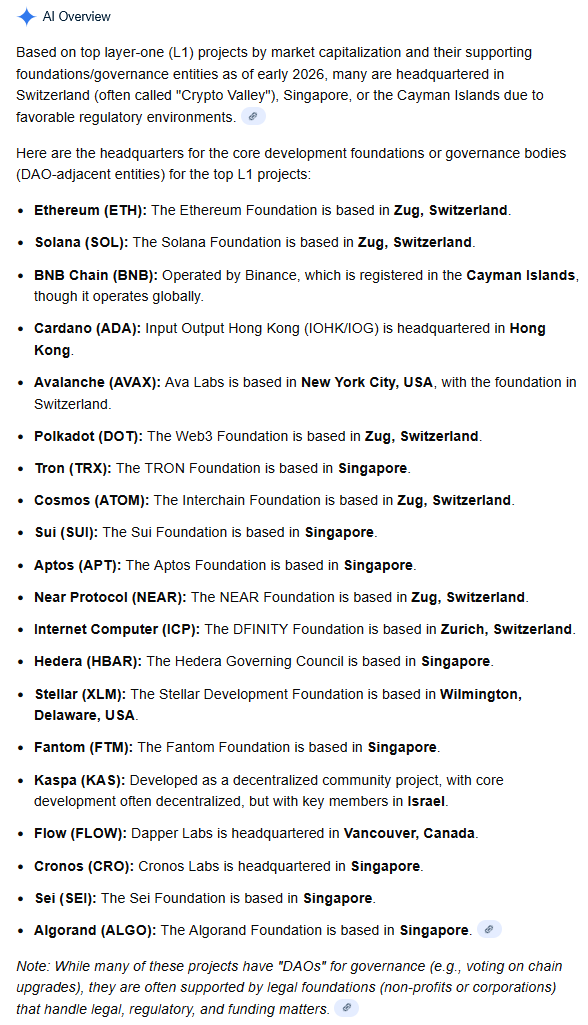
It is my belief that the Cayman Islands would be a much better fit for RTJL’s successor entity:*
- Virtually every Layer One cryptocurrency uses Cayman for their Foundation. Examples: Ethereum Foundation, Solana Foundation, Polkadot Foundation, Avalanche Foundation, Aptos Foundation, Sui Foundation.
Incorrect. See AI output above.
- Cayman is neutral, boring, and understood by regulators. Suited to projects with a global base of investors and significant treasuries.
It also suffers from the perception issue globally of secrecy, tax avoidance and other nefarious activities (e.g. Panama Papers…etc). We want to promote transparency above all and with community governance vs. the Cayman model of electing a “board” or “council” that hopefully performs what we need them to do.
By going with the Cayman model we would effectively be trading one quasi-secretive actor (Jersey Foundation) for yet another one. Again, my opinion.
- Cost: around $30–40k up front, around $10k a year. I have no idea how much money is left in RTJL; if this is unaffordable, the other option would be to register in Panama as a bridge until the XRD price can recover. But a Wyoming DUNA is significantly more expensive than Panama too. The good thing about Cayman is that the costs are relatively stable year-on-year, as opposed to the US where costs will rise every year, possibly by a lot.
Not sure where you received your quotes from. I would like to verify those figures independently.
Your statement that the WY DUNA is significantly more expensive is not based on the facts available and published in countless examples and publications. I have no clue where you derived your opinion of these costs from so please share your source.
As for costs rising year over year in the US, that is also an unfounded statement of opinion. Please provide sources for your assumption.
Thanks!